
PPL(H)
Private Helicopter Pilot Training (PPL(H)) in Aix-en-Provence
Dreaming of becoming a helicopter pilot? You're in the right place: the Rotor Club Aixois flight school and its instructors will support you in making it happen!
Discover the thrill of flying by booking a discovery flight before committing to a licence course. This first flight gives you a unique opportunity to take the controls alongside an experienced instructor, feel the magic of flight, and decide whether this adventure is for you. Whether you're after a one-off flying lesson or a full training course all the way to the licence, our flight school adapts the pace to your project.
The Private Pilot Licence – Helicopter (PPL(H))
The Private Pilot Licence – Helicopter (PPL(H)) has been governed by the European JAR-FCL 2 standards since 1 January 2006, guaranteeing standardised, high-quality training. You must be at least 16 to fly your first "solo" flight. If you're a minor, parental authorisation will be required.
You must obtain a medical certificate confirming your physical and mental fitness to act as a private helicopter pilot, issued by a doctor approved by the French civil aviation authority (DGAC).
Training is divided into several phases, from basic handling to navigation, including cross-country flights. Your progress is closely tracked with an individual training logbook. Flight instruction requires a regulatory minimum of 45 hours. If you already hold an aeroplane or glider pilot licence, you can benefit from a 10% reduction on your Pilot-in-Command (PIC) hours, up to a maximum of 6 hours.
Age requirements
- Minimum age 16 for the first solo flight
- Must have turned 17 by the day of the final practical test
- Class 2 medical certificate issued by a DGAC-approved doctor
Medical certificate
A class 2 medical certificate, issued by a DGAC-approved doctor, is required before starting flight training. We can point you towards the right doctors in the region.
Theoretical exam
The exam is made up of 9 multiple-choice modules (air law, meteorology, navigation, performance, general aircraft knowledge…). Theory can be prepared at your own pace, alongside flight training.
Since the DGAC reform of 4 December 2023, each subject below is assessed as an independent theory exam (minimum 75% correct answers per subject), rather than a combined score across 2 papers. This split into "common" and "specific" groupings remains useful to distinguish the shared aeronautical core from the helicopter-specific subjects — in total, the PPL(H) theory exam covers 9 exams, 128 questions and 212 minutes.
Common aeronautical paper
| Subject | Questions | Duration |
|---|---|---|
| Air law | 20 | 30 minutes |
| Human performance | 12 | 18 minutes |
| Meteorology | 20 | 30 minutes |
| Communications | 8 | 12 minutes |
| Total | 60 | 90 minutes |
Helicopter-specific paper
| Subject | Questions | Duration |
|---|---|---|
| Navigation | 20 | 50 minutes |
| Principles of flight | 12 | 18 minutes |
| Operational procedures | 12 | 18 minutes |
| Flight performance and planning | 12 | 18 minutes |
| General aircraft knowledge | 12 | 18 minutes |
| Total | 68 | 122 minutes |
Flight training
Regulatory minimum of 45 flight hours, including:
- 10 hours of solo flight
- One 100 Nm (185 km) cross-country flight with 2 landings at 2 different aerodromes
Practical test
About 2 hours of in-flight testing with an examiner (FE(H), TRE(H), IRE(H) or SFE(H)).
How does the training actually work?
At every stage, an individual training logbook tracks your progress. Your instructor adapts the pace to your personal progression.
- 1
Phase 1 — Familiarisation and piloting basics
Getting to grips with the helicopter, mastering the controls (cyclic, collective, anti-torque pedals), take-offs and landings, hovering.
- 2
Phase 2 — Mastery and autonomy
Cross-country flights, navigation, handling failures, autorotations. First solo flight.
- 3
Phase 3 — Navigation and refinement
Long-distance navigation, flights in controlled airspace, preparation for the practical test.
On video
This is what you'll be flying
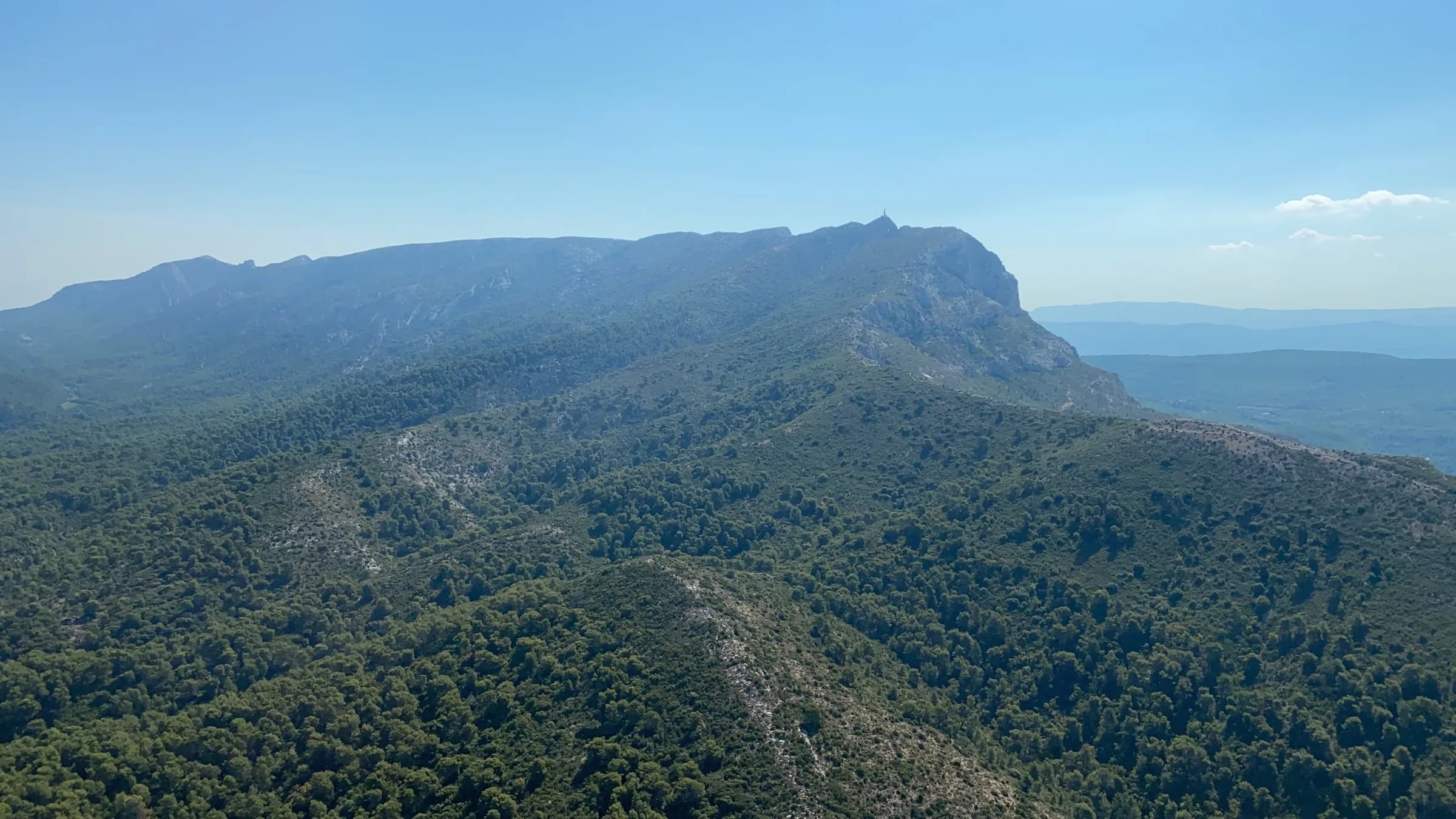
The view from the controls of a Rotor Club Aixois helicopter, in flight above Provence.
Can I train for the PPL(H) while working?
Yes, absolutely. The vast majority of our student pilots train alongside their professional activity. We recommend a pace of 1 to 2 lessons a week — at that pace, training takes between 9 and 12 months.
You arrange your slots directly with your instructor based on your availability. Flights take place 7 days a week, depending on weather and scheduling.
Accessible from across the PACA region
Rotor Club Aixois is based at Aix-les-Milles aerodrome (LFMA), ideally located in the heart of the Provence-Alpes-Côte d'Azur region:
- Aix-en-Provence10 minutes
- Marseille25 minutes
- Salon-de-Provence20 minutes
- Arles / Avignon40 minutes
- Toulon50 minutes
Provence also offers exceptional weather conditions for training: over 300 days of sunshine a year and varied airspace — plains, mountains, coastline — that naturally enrich the training.
Frequently asked questions about the PPL(H)
How long do I have to pass the 9 PPL(H) theory exams?
You have 18 months from your first attempt, spread over a maximum of 6 exam sessions, with at most 4 attempts per subject. After that period, any subjects already passed no longer count and you must start over.
Where and how do I register for the PPL(H) theory exam?
Registration is done through the DGAC's OCEANE platform or through SMILE Examens, the French Aeronautical Federation's (FFA) platform. We support you through this administrative process.
Is the pass mark the same for every subject?
Yes: each of the 9 exams requires at least 75% correct answers, assessed independently. An excellent score in one subject doesn't make up for a poor score in another.
If I fail, do I have to retake the entire theory exam?
No — that's the whole point of the format in force since 4 December 2023: each subject is independent, so you only retake the ones where you didn't reach 75%, within a limit of 4 attempts per subject and 18 months overall.
What's the overall cost of PPL(H) training at Rotor Club Aixois?
The cost depends on the number of hours needed, which varies from student to student, and on the aircraft chosen for training. Contact us for a personalised quote suited to your profile and availability.
Information and enrolment
Have questions about PPL(H) training, rates or how to enrol? Contact us — we'll reply within 24 hours and can arrange a visit to the aerodrome and a meeting with an instructor.
Contact us